


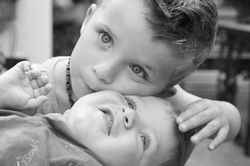
One of the projects we have dedicated our support to was assisting the family of Klára Taussig and her two young sons, Theodor and Oskár. Unfortunately, both boys suffer from a serious and incurable condition – Duchenne Muscular Dystrophy (DMD).
This situation represents an extraordinarily difficult life trial for the entire family. Klára, a practicing Buddhist under the guidance of Venerable Visuddhi, continues to care for her family with great determination despite these challenging circumstances, while simultaneously developing her mind on the path of Dhamma. Her approach is a profound testament to inner strength, patience, and the courage to face reality as it is.
Our assistance was not only financial. In addition to direct support for the family and contributions toward research that may one day bring hope to children with this condition, human and spiritual support played a significant role. Venerable Visuddhi has repeatedly visited the family in England, where they currently reside, providing personal support, guidance, and a space for sharing and calming the mind during difficult moments.
Such support often carries a deeper meaning than any material aid. In situations where a family must cope with a serious illness affecting their children, the presence of understanding, compassion, and inner stability is essential. It helps carry the weight of circumstances that cannot be changed but can, with the support of others, be experienced with greater peace and dignity.
What is Duchenne Muscular Dystrophy (DMD)?
Duchenne Muscular Dystrophy is a genetic disorder that affects approximately one in every 3,600 to 6,000 live male births. It is an X-linked disease, meaning it manifests almost exclusively in boys, while women may be carriers.
In approximately 35% of cases, the condition arises due to a spontaneous genetic mutation and can therefore appear in families with no previous genetic history. The disease is caused by the absence of dystrophin – a protein essential for the proper function of muscle cells.
Children are typically born without obvious symptoms. These begin to appear gradually around the age of two, when the first difficulties with movement manifest. The disease leads to the progressive weakening and loss of muscle mass. Over time, walking becomes impossible, and the use of a wheelchair becomes necessary.
Unfortunately, there is currently no cure for this disease. However, ongoing research offers a degree of hope for the future.
This project was not just another form of aid for us. Above all, it was an encounter with a specific human story that reminds us of the fragility of life and, at the same time, the strength of a heart that does not give up.
We thank everyone who participated in this support from the bottom of our hearts. Thanks to you, this family could feel that they are not alone in their situation.
 |  |
|---|---|
 |  |
 |  |
 |  |
 |
Support Suriya Lamai – Children of the Sun
Spolek Karuṇā Sevena
Bank account: 6855679001/5500
IBAN: CZ49 5500 0000 0068 5567 9001
SWIFT: RZBCCZPP
Slezská 3, 796 01 Prostějov, Czech Republic
karuna.sevena.en@gmail.com
With a heart of compassion (karuṇā), this project supports children in Sri Lanka who live in difficult conditions—helping them receive education, care, and the basic support needed for a dignified life.
Donations are tax-deductible in the Czech Republic.
Please include the note: “For the Children of SL.”
As this is not a public collection, kindly include your contact details so we may provide a donation agreement or receipt.
Thank you for helping to bring care, stability, and hope where it is most needed.
Links for donation:


We cooperate:
