


This page is devoted to the practice of mindfulness of the body through the various bodily postures (iriyāpatha), as taught in the early Buddhist texts. This is not a special meditation technique nor a method for attaining particular states. It is the direct knowing of the body as it is – in every situation and in every posture.
Whether sitting, standing, walking, or lying down, the body is always present. Through it, we learn to develop continuous mindfulness that gradually extends into all aspects of daily life.This practice is simple, yet profound. It requires nothing special – only the willingness to pause, to feel, and to know.
Iriyāpatha refers to bodily postures. Within the practice of satipaṭṭhāna, it is a fundamental way of establishing mindfulness through the body in everyday life.
Meditation is not limited to sitting. It can be cultivated in four primary postures:
-
sitting (nisinna),
-
standing (ṭhita),
-
walking (gacchanta),
-
and lying down (sayāna).
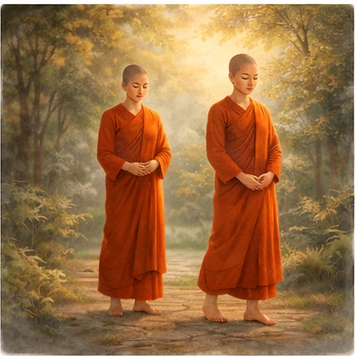

The Buddha repeatedly emphasized clear awareness of the body in all activities:
“A monk acts with full awareness when going forward and returning, when stretching and bending, when wearing robes and carrying the bowl, when eating and drinking, chewing and tasting… when walking, standing, sitting, falling asleep and waking up, when speaking and remaining silent.” (MN 57)
And further:
“When walking, he understands: ‘I am walking.’
When standing, he understands: ‘I am standing.’
When sitting, he understands: ‘I am sitting.’
When lying down, he understands: ‘I am lying down.’
Thus he clearly comprehends the posture of his body.” (MN 10)
Purpose of the Practice
The aim is not to attain a special state, but to know the body as it is, in each moment.
This practice develops:
-
stability of mind
-
presence
-
continuous mindfulness in daily life
How to Practice | General Conditions
Choose a quiet place where you will not be disturbed. The environment should not be too hot or too cold, too dark or too bright.
Such conditions help reduce distraction and drowsiness, which are among the main hindrances.


Sitting (nisinna)
Sit in a position that is stable yet relaxed. This may be cross-legged, half lotus, full lotus, or another comfortable posture.
-
The spine is upright (ujuṃ kāyaṃ), but not rigid.
-
Shoulders relaxed, hands resting in the lap.
-
Chin slightly tucked, gaze soft (eyes open or closed).
If sitting on the floor is uncomfortable, a chair may be used – feet flat on the ground, back upright.
Standing (ṭhita)
Stand upright, feet hip-width apart, weight evenly distributed.
The body is relaxed yet alert. Feel the stability and contact with the ground.
Walking (gacchanta)
In walking meditation, walk slowly and deliberately.
Attention rests on the movement itself – each step.
At the end of the path, stop, become aware of standing, then mindfully turn and continue.


Lying Down (sayāna)
This posture is suitable before sleep or when the body cannot sit.
Traditionally, one lies on the right side, body relaxed, mind alert.Practice continues as ongoing awareness.
What to Be Careful About
-
unnecessary tension in the body
-
drifting into dullness or sleepiness
-
trying to “achieve something” instead of simply knowing
In whatever posture the body is, the practice is to know it as it is.
Support of the venerable Bhikkhunī Visuddhi and activities of the Association Karuṇā Sevena:
Bank account for donations:
-
Account number: 6855679001/5500
-
Account holder: Karuṇā Sevena Association
-
IBAN: CZ49 5500 0000 0068 5567 9001
-
SWIFT: RZBCCZPP
-
Address: Slezská 3, 796 01 Prostějov, Czech Republic
-
Email: karuna.sevena.en@gmail.com
The funds are used to cover the basic monastic needs of the venerable bhikkhunī Visuddhi
such as robe, food, medicine and abode this also covers transportation, accommodation, air tickets, etc.) distribution of books,
the furnishing of the ārāma Karuṇā Sevena, insurance, utility bills, etc. Tax-deductible in the Czech Republic.
Please state the reason for the donation with the following note "For the Association Karuna Sevena."
Neither of the above is a public collection, and therefore we ask all donors to add their contact information to their gift, so that we can issue a donation agreement contract or a donation receipt. We thank all the donors.
Links for donation:


We cooperate:

