



The practice of satipaṭṭhāna – the Four Foundations of Mindfulness – is described in the Buddha’s teaching as a direct path to understanding and purifying one’s experience. It is not abstract theory, but a living practice that unfolds in each moment of life.
"And what, bhikkhus, is the noble truth of the origin of suffering?
It is that craving which gives rise to birth, bound up with pleasure and passion, finding fresh delight now here, now there:
that is to say craving for sensual pleasures, craving results from actions, and craving no results from actions.
And where does this craving arise and establish itself?
Wherever in the world, there is anything agreeable and pleasurable, there craving arises and establishes itself.“
Mahā Satipaṭṭhāna sutta MN10
The four foundations of mindfulness
-
The first foundation, contemplation of the body (kāyānupassanā), means becoming aware of the body as it truly is. We begin with simple awareness of breathing – knowing when we breathe in and when we breathe out. Gradually, we include movement, posture, and daily activities. We train to “know what we are doing while we are doing it,” grounding the mind in the present.
-
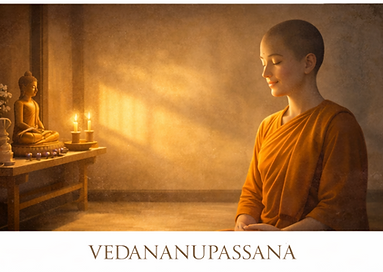
The second foundation, contemplation of feelings (vedanānupassanā), is the observation of how each experience feels. Every contact brings a feeling – pleasant, unpleasant, or neutral. We learn to recognize these feelings and observe them without clinging or resistance, seeing clearly that they arise and pass away.

-
The third foundation, contemplation of mind (cittānupassanā), is awareness of the state of the mind itself. We notice whether the mind is calm or restless, focused or distracted, affected by desire, aversion, or clarity. Without judging, we simply know: “this is the state of the mind now.” This brings understanding and distance.
-
The fourth foundation, contemplation of mental phenomena (dhammānupassanā), deepens this insight further. Here we begin to recognize how the mind operates – for example, when hindrances arise, how they arise, and how they pass away. We also begin to see broader structures of experience, such as the aggregates and the Four Noble Truths, directly in our own experience.
This practice is not limited to formal meditation. Its true strength lies in the ability to cultivate it throughout daily life – while walking, speaking, eating, or working. Every moment becomes part of the path.
Today, meditation is often presented as separate techniques such as samatha or vipassanā. In the early teachings, however, the Buddha primarily points to this direct practice of mindfulness through the four satipaṭṭhānas, within which calm and insight naturally develop together. It is not about performing a technique, but about learning to see clearly.


These four foundations are not separate practices – they naturally interweave. When we are aware of the body, we also encounter feelings, mind states, and mental processes. In this way, practice deepens and leads to clear seeing: everything arises and passes away.
The key is continuous mindfulness – a simple, direct knowing of what is happening. Through this, the mind gradually turns away from what is unwholesome and inclines toward what is beneficial, leading step by step toward liberation.
For a more detailed explanation based on the teachings of Venerable Pemasiri Thera, you may read an excerpt from the book Walking the Tightrope: ...read more >
Support of the venerable Bhikkhunī Visuddhi and activities of the Association Karuṇā Sevena:
Bank account for donations:
-
Account number: 6855679001/5500
-
Account holder: Karuṇā Sevena Association
-
IBAN: CZ49 5500 0000 0068 5567 9001
-
SWIFT: RZBCCZPP
-
Address: Slezská 3, 796 01 Prostějov, Czech Republic
-
Email: karuna.sevena.en@gmail.com
The funds are used to cover the basic monastic needs of the venerable bhikkhunī Visuddhi
such as robe, food, medicine and abode this also covers transportation, accommodation, air tickets, etc.) distribution of books,
the furnishing of the ārāma Karuṇā Sevena, insurance, utility bills, etc. Tax-deductible in the Czech Republic.
Please state the reason for the donation with the following note "For the Association Karuna Sevena."
Neither of the above is a public collection, and therefore we ask all donors to add their contact information to their gift, so that we can issue a donation agreement contract or a donation receipt. We thank all the donors.
Links for donation:


We cooperate:

